

Understanding Autism Through a Socio-Cultural Lens: Insights from Ghana’s Child and Adolescent Mental Health Clinic
By: Dr. Pearl Adu-Nyako MD, MGCPS, Department of Psychiatry, Komfo Anokye Teaching Hospital, Emmanuella Oduro BSc. Biological Science. KNUST, Mindpearls Consortium | 2025.
Introduction
Autism Spectrum Disorder (ASD) prevalence is on the increase as a public health concern worldwide. It manifests with a variety of developmental challenges in three broad areas, but with highly variable manifestations. It is managed in a highly variable manner, largely based on a complex interaction between multiple factors, some of which are sociocultural, economic, and related to policy dynamics present in the affected individual's country of residence. In Ghana and much of Sub-Saharan Africa, sociocultural beliefs, norms, religious interpretations, limited diagnostic tools, and resources shape how families perceive and respond to autism. These factors and several others can affect the presentation, clinical diagnosis, and selection of interventions for management. This article explores the possible findings anticipated from an ongoing study at the Komfo Anokye Teaching Hospital (KATH), one of Ghana’s leading healthcare institutions that provide child and adolescent mental health care services,. highlighting how socialization and culture intertwine with ASD and may impact diagnosis and/or care.
Prevalence of ASD in Ghana compared to US and Canada
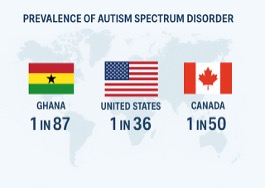
Figure 1: Prevalence of Autism Spectrum Disorder
Autism in Context: The Ghanaian Perspective
Globally, ASD is characterized by persistent challenges in social interaction and communication, alongside repetitive behaviors and restricted interests. In Ghana, these features are often filtered through a spiritual, social, cultural or behavioral lens. Behaviors such as limited eye contact or repetitive movements may be seen not as developmental markers of diversity, but as signs of “spiritual affliction” or “disobedience” (1,2).
This perception delays formal diagnosis and care, as families often turn first to prayer camps, herbalists, or community elders, or they completely resign from seeking intervention. By the time medical professionals are consulted, many children have already missed the early developmental window where intervention is most effective (3).
Sociocultural Influences on Diagnosis
The KATH Child and Adolescent Mental Health Clinic (CAMHC) offers a unique vantage point for research into understanding how cultural and social dynamics influence autism diagnosis and intervention needs. The ongoing research aims to examine how sociocultural factors, including gender expectations, family structure, and community beliefs, influence the presentation and recognition of ASD.
Preliminary findings suggest that:
- Spiritual explanations for ASD remain common.
- Mothers are often blamed for the condition.
- Urban families are more likely to seek psychiatric help, while rural families rely on traditional or religious approaches.
- Girls are frequently underdiagnosed.
These findings underscore the urgent need for culturally sensitive diagnostic tools that recognize how symptoms manifest within Ghanaian sociocultural contexts.
Pathways to Child and Adolescent Mental Health Care in Ghana
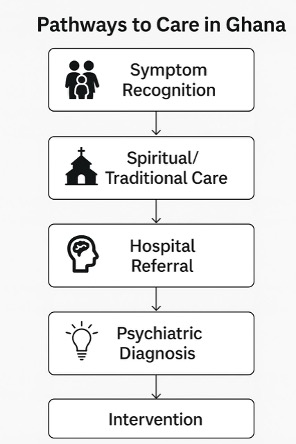
Figure 2: Pathways to Care in Ghana
Challenges with Western Diagnostic Tools
Most diagnostic frameworks used in Ghana, such as the ICD-11 and Modified Checklist for Autism in Toddlers (M-CHAT-R/F), were developed in Western contexts (4,5). While effective globally, these tools often fail to account for local social behaviors or communication norms.
For instance, maintaining direct eye contact with adults is discouraged in many Ghanaian households. Thus, a lack of eye contact, often a diagnostic marker in Western assessments, may not signal developmental impairment but rather social etiquette. Similarly, speech delays or quietness in girls may be interpreted as politeness or shyness rather than a clinical concern.
Without contextual adaptation, these tools risk misdiagnosis or underdiagnosis, leaving many children without needed services (6).
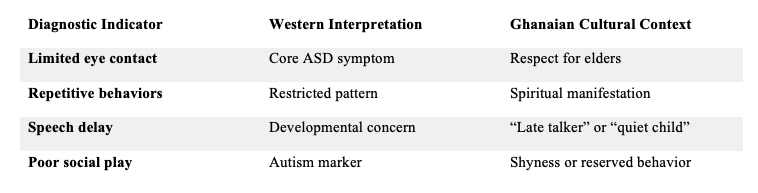
Figure 3: Comparison Table – ICD-11 vs. Ghanaian Context
Toward Cultural Adaptation and Inclusion
The KATH CAMHC is preparing for a mixed-method approach that combines quantitative analysis of clinical features with qualitative insights from caregivers. Through interviews and focus groups, caregivers express frustration, stigma, and isolation but also resilience and hope. Many families advocate for public education and faith-community collaboration to reduce stigma.
The project’s goals include:
- Establishing a national ASD profile that reflects Ghanaian diversity.
- Identifying gaps between ICD-11 criteria and local presentations.
- Developing context-sensitive diagnostic guides for early detection.
- Training healthcare workers to enhance cultural competence.
Research Model Diagram
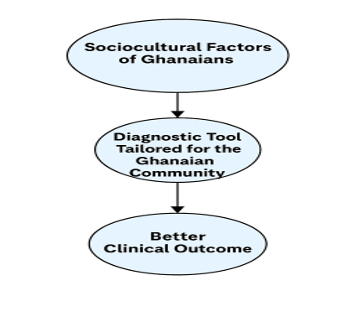
Figure 4: Research Model Diagram
Policy and Practice Implications
Culturally tailored approaches to ASD diagnosis and care are critical to ensuring equity in mental health services. Policymakers should:
- Support local validation of diagnostic tools.
- Expand awareness campaigns through schools, churches, and community media.
- Provide training for healthcare professionals in cultural sensitivity.
- Encourage collaboration among families, traditional leaders, and clinicians.
The research is expected to form the foundation for developing Ghana’s first culturally validated autism diagnostic framework, aligning with IACAPAP’s mission to promote global child and adolescent mental health through culturally informed practice.
Conclusion
A comprehensive approach to care for individuals with autism is the gold standard recognized globally, which needs to be associated with a cultural and social phenomenon shaped by the beliefs and systems surrounding each child. Ghana’s growth in research in this field can power contextual understanding in improving early detection and support.
By bridging Western diagnostic science with Ghanaian cultural realities, we can create a more inclusive model of care that recognizes both the universality and diversity of autism.
Acknowledgement
I am sincerely grateful to Dr.Ama Addo, Royal College of Psychiatry UK for her mentorship, Dr. Eugene Dodoye, CEO Mental Health Authority and Mr. Boakye-Yiadom Jonathan's support throughout this work.
References
- Sofolahan YA, Adebiyi AO. Religious and cultural beliefs and practices: Impact on African children with disabilities. Afr J Disabil. 2012;1(1):13.
- Nkansa-Dwamena E, Osei AO, Adomako SA. Stigma and autism in Ghana: Family and community perspectives. Ghana J Ment Health. 2019;11(1):24–33.
- Boateng B, Amankwah EA, Opoku MP. Autism spectrum disorders in Ghana: Perspectives on symptoms, stigma, and interventions. Afr J Autism Dev Disabil. 2022;4(2):98–107.
- World Health Organization. ICD-11 Classification of Mental and Behavioral Disorders. Geneva: WHO; 2016.
- Robins DL, Casagrande K, Barton M, Chen CM, Dumont-Mathieu T, Fein D. Validation of the M-CHAT-R/F. Pediatrics. 2014;133(1):37–45.
- Kareem A, Sulaiman A. Perceptions and cultural implications in autism spectrum disorder in Africa. Int J Soc Psychiatry. 2020;66(2):168–74.
- Keenan M, Dillenburger K, Moderato P, Röttgers HR. Autism spectrum disorder in low- and middle-income countries: Policy and practice. J Autism Dev Disord. 2022;52(5):1990–2005.
- Abubakar A, Ssewanyana D, Newton CR. A systematic review of research on autism spectrum disorders in sub-Saharan Africa. Behav Neurol. 2016; 2016:1–14.
- Osei A, Amponsah K, Nkansa-Dwamena E. Cultural perspectives on autism spectrum disorder in Ghana. J Ghanaian Ment Health. 2020;3(2):14–28.
- Franz L, Chambers N, von Isenburg M, de Vries PJ. Autism spectrum disorder in sub-Saharan Africa: A comprehensive scoping review. Autism Res. 2017;10(5):653–74.
This article represents the view of its author(s) and does not necessarily represent the view of the IACAPAP's bureau or executive committee.
