

IACAPAP President's Message Mar 2026
By: Professor Luis Augusto Rohde, Professor, Department of Psychiatry, Federal University of Rio Grande do Sul, Director, ADHD Program, Hospital de Clínicas de Porto Alegre, Brazil.
It is very sad to be writing this first 2026 presidential column at the moment where the world is facing a new emerging war with unpredictable consequences other than the fact that suffering will again devastate thousands of families and their children. We, at IACAPAP, continue exploring opportunities to work jointly with other international associations to help national mental health associations in impacted countries.
As usual, I want to share with you some news on what we have been developing in IACAPAP since our last bulletin.
First, we just received a letter from the World Health Organization informing us that IACAPAP was approved as Non-State actor in official relations with WHO. Some non-State actors are granted "official relations" status by the WHO Executive Board, a privilege for organizations with sustained, systematic engagement in public health.
Second, we are finishing the preparation of the World Infant, Child and Adolescent Mental Health Day (WICAMHD) in partnership with the International Society for Adolescent Psychiatry and Psychology (ISAPP), the World Association for Infant Mental Health (WAIMH), and the World Psychiatric Association - Child and Adolescent Psychiatry Section (WPA-CAP). This year, we will return to the original day, April 23rd. The theme is “Developing Emotional Safety and Preventing Suicide in a Post-Pandemic World”, and the meeting will be chaired by our IACAPAP past president, Daniel Fung. We will also go back to an online format. Thus, I invite you to be with us in this very relevant initiative.
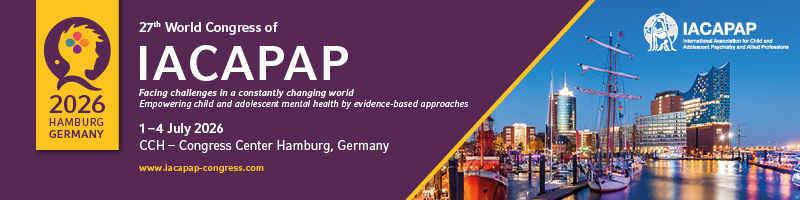
Third, the final preparations for our next World Congress in July are in place. The 25 fellows that will take part in the Donald J. Cohen Fellowship Program (DJCFP) were selected from 280 applications. They come from 21 countries. We received an astonishing number of submissions for oral presentations and posters. Thus, we made every effort to increase the number of presentations at the congress to allow a huge exchange of ideas, projects, and findings while keeping high scientific and ethical standards in the review process. I would like to thank our review committee composed of 29 clinicians, researchers and experts. Each of them reviewed dozens of submissions. I am very happy to share with you the news that we will have more than 890 oral presentations and posters at the congress! I am sure you will enjoy taking part in this meeting. Thus, I invite you to register as soon as possible. As said before, we have space limitations in the venue and we might have to cap registrations at a certain number, as was the case in Rio de Janeiro’s congress. If you want to know more about the speakers’ line-up, symposia and the congress in general, please navigate our congress website.
Regarding the two areas of collaboration between IACAPAP and the Stavros Niarchos Foundation (SNF) Global Center for Child and Adolescent Mental Health at the Child Mind Institute. Here are the updates:
- SNF Global Center Clinical Fellowship Program for Low- and Middle-Income Countries (LMICs): The first cohort of Mozambican fellows just finished the second and last year of the program that was developed in Mozambique with both local and remote supervision from Brazil. The second cohort just finished their first year of training in Brazil two weeks ago and they are moving to a second year of training in Mozambique while the third cohort is beginning their first year of training in Brazil. We just had a wonderful meeting with fellows from these second and third cohorts, the Director of Fellowship Strategy at the SNF Global Center local and Mozambican mentors in Porto Alegre, Brazil where the second cohort hand the baton to their colleagues of the first cohort. I am also happy to announce that the first cohort of Kenyan fellows was selected. The fellows – psychiatrists Muthoni Muthiga and Milcah Olando, and psychologist, Mercy Chege – began their fellowship training in February 2026 in Kenya, working on the IACAPAP curriculum and meeting with other SNF Global Center Fellows. The Fellows are expected to arrive in South Africa in March to begin in-person activities.
- LUMI (Library of Universal Mental Health Instruments) – A Free Assessment Tool to Support Culturally Appropriate Global Data Collection for Child and Adolescent Mental Health: Progress continues in strengthening the scientific rigor and usability of LUMI. Visual identity has been finalized with input from a global professional advisory group and a youth council. A dedicated website will be launched soon to foster a community of professionals interested in contributing to and utilizing LUMI. On the scientific front, item refinement is ongoing to enhance the specificity and precision of outcome measurement. A consolidated manuscript describing the development of LUMI, including its cultural, linguistic, and psychometric validation processes, is currently in preparation. The draft will be circulated in the coming months to professionals involved in the development process for feedback. The first three national surveys using LUMI are being planned in Greece, Brazil, and South Africa. The development team anticipates that LUMI will be available for use within clinical and research settings by late 2026 or early 2027. As usual, we encourage you to read more about this work on the SNF Global Center’s website here.
As the committee headed by Professor Daniel Fung is finishing the selection for the next Executive Committee, we expect to have the composition of the proposed new Bureau in the May. Please keep your eyes on our website for news about the new leadership in IACAPAP as well as the nominees for the IACAPAP Medal and the International Contribution Award.
Our ante-penultimate paragraph is always dedicated to calling your attention to an impactful paper recently published on CAMH in scientific literature. This time, I would like to share your attention for a paper published in the British Medical Journal on the benefits and harms of ADHD interventions (Gosling CJ et al. Benefits and harms of ADHD interventions: umbrella review and platform for shared decision making. BMJ. 2025 Nov 26;391:e085875. doi: 10.1136/bmj-2025-085875). Why do we highlight this paper if we have some other recent meta-analyses on the topic in the field? For two main reasons: 1) This is the most comprehensive and standardized review of evidence across different pharmacological and non-pharmacological treatments, age groups, and different outcomes; 2) The authors provide their findings in an open-access, easy to use and continuously updated online platform to make both complex evidence accessible for clinicians and to support shared decision making in clinical practice. Moreover, it is already translated in 7 languages – see the platform at https://ebiadhd-database.org/.
Finally, regarding the auditable proposed goals in the previous bulletin, they have been partially achieved since:
- We already have both the program completed for our World Congress in Germany and an expressive number of registrations for the congress.
- Due to budgetary restrictions, we did not define yet another pair of countries for the SNF Global Center Clinical Fellowship Program for Low- and Middle-Income Countries.
- We had the visual identity for the LUMI defined and we are preparing submissions on the process describing its creation and cultural, linguistic and psychometric validations.
- We expect to have LUMI available for use in the clinical and research worlds by the worldwide community of CAMH professionals in the second semester of 2026/first trimester of 2027.
- The list of research priorities on digital environments and youth mental health for the next three years as a result of collaborative work with WHO and Orygen is to be launched in the next few weeks.
Our auditable goals up to the next bulletin are:
- A report for our term at the IACAPAP bureau in our next presidential column.
- Everything ready for the World Congress in Germany and more than 2000 registrations for the congress.
- LUMI data collection occurring in three countries and papers describing its creation and cultural, linguistic and psychometric validations in final process of submission.
- The process of having LUMI available for use in the clinical and research worlds by the worldwide community of CAMH professionals in the second semester of 2026/first trimester of 2027 running without delays.
- The list of research priorities on digital environments and youth mental health for the next three years as a result of collaborative work with WHO and Orygen launched.
I hope you all enjoy reading our Bulletin.
