
Healing After Disaster: Creating a Children’s Workbook after the Earthquakes in Türkiye
By: Hanife Nur Akal, MD1, Alexandra Harrison, MD2, Büşra Uğur, MSc, Prof. Dr.Zeynep Simsek3
1Children’s National Hospital & George Washington University School of Medicine and Health Sciences, 2Supporting Child Caregivers and 3İstanbul Bilgi University, Türkiye
When the devastating earthquakes struck southern Türkiye and northern Syria in February 2023, I was thousands of miles away, completing my child and adolescent psychiatry fellowship in the United States. Like many Turks living abroad, I watched the images of collapsed homes and grieving families with disbelief and sorrow. I felt heartbroken and helpless – wanting to help, yet unsure how.
In those early weeks, I met Dr. Gilbert Kliman, a pioneer of trauma-narrative workbooks. He shared a simple but powerful idea: children can begin to heal by telling their story – not alone, but with the guidance and emotional support of a trusted adult. That idea became a compass in the chaos. Together with my mentor Dr. Alexandra Harrison, I began developing Healing After Disaster, a caregiver–child workbook designed to help families process their experiences safely and together.
We built the workbook around the five core principles of Psychological First Aid (PFA) – safety, calming, connectedness, self-efficacy, and hope. The story moves gradually from the child’s sense of self outward to their family, friends, community, and town, helping them restore a sense of continuity and belonging. Each page offers space for drawing, reflection, and shared conversation.
The workbook invites the child to be both author and protagonist – giving voice and agency to express what matters most, in their own way. It is not a task or assignment; families can return to it whenever they feel ready.
With no funding and only my laptop, I created the first version in PowerPoint – one small bridge toward communication.
At first, I had no local partners, and for many months, the workbook remained a prototype. Then, nearly a year after the earthquakes, the project found its home. I connected with the remarkable İstanbul Bilgi University team – led by Prof. Dr. Zeynep Şimşek, Dean of the Faculty of Health Sciences and an expert in social work in public health and disaster response. She and her graduate students embraced the project and brought it to Hatay, one of the regions most deeply affected.
Nearly a year later, families were still living in container homes, aftershocks continued, and infrastructure and basic services were still very limited. Amid these challenges, the Bilgi team introduced Healing After Disaster for the first time. They led small sessions with mothers and children and gathered feedback from local professionals. Their work reflected a principle shared by mentors like Dr. Harrison and Dr. Şimşek: recovery begins in relationships and grows through community trust.
The culturally adapted workbook for Hatay included new modules on emotional and behavioral reactions to trauma, caregiver–child co-regulation, an age-appropriate explanation of “what an earthquake is.” We simplified the language, redesigneded visuals to reflect local life, and returned often to one guiding question: Does this feel safe and true for the families who will use it?
The pilot phase was small and exploratory. While formal results will be reported separately, one family’s story revealed more than any data point.
Months after the first field visit, Büşra received a message from a mother who wanted to share that her daughter had finally completed the workbook. Her heartfelt note showed how healing had quietly taken place over time.
In the mother’s words:
“Shortly after the earthquake, I met a psychologist, Büşra. She offered support not only to me but also to my daughter. She recognized how important it was for my daughter to make sense of what had happened and to heal from the trauma. To help with this, she gave us a book filled with activities, designed to guide my daughter through the process of understanding and coping with her emotions.
At first, I hid the book from her, because I didn’t know how to handle her emotions. But then, when I felt ready with the help of Büşra, I kept the book in a visible place in our homes—the container, the tent—where we lived, where it was always within reach. Finally, when we moved to our prefabricated home, she seemed ready. My daughter decided she would start working on it, when life felt more stable. ‘Mom, shall we write the story of my life?’ Her words stayed with me. That book became more than just pages of activities. It became a way for us to reflect, share, and heal. It was a journey of resilience—of finding hope amidst loss, and of rebuilding not just our home but our hearts.”
It had been raining the morning the earthquake struck. In one of her daughter’s drawings, half the page shows sun and happiness, and the other half shows rain and tears – a reflection of that day and of how light and sadness now live side by side. Her daughter, five years old at the time, didn’t yet know how to read or write, so her mother gently wrote captions beside each drawing – simple notes that gave words to her child’s feelings.

Figure 1:
About My Friends and Other People that I Love:
If I need help, I first go to my mother. When I feel sad, my mother hugs me, and I feel better. My mother taught me how to walk.
(Drawing “My mother is teaching me how to walk”).
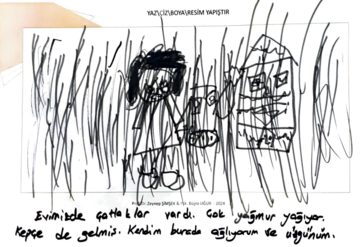
Figure 2: “There are cracks on the walls of our home. It’s raining a lot. An excavator came to demolish our house. This is me – I am sad and crying.”
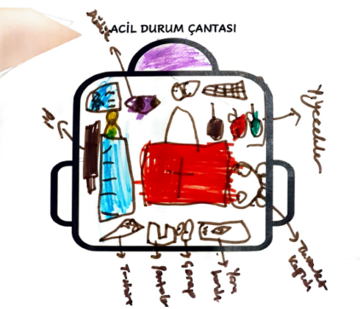
Figure 3: Emergency Bag
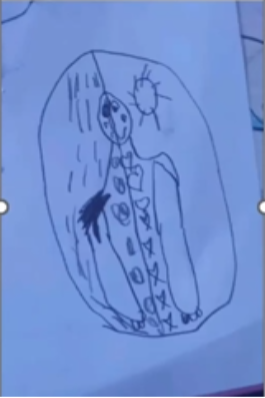
Figure 4: Mother shared in her video message
Mothers later described the guide and the workbook as transformative:
- “This book felt like gold to me — I felt lighter, almost like a bird. Our mutual trust increased.”
- “I learned what to do when my child’s behaviors changed after the earthquake.”
- “I became more patient; I learned to regulate my own reactions.”
- “My child used to be frightened even by the sound of the toilet flush; I’ve noticed her fears have decreased.”
- “I now know my child better; I know what to do in difficult moments.”
These reflections reminded us that healing has its own rhythm – readiness cannot be rushed or scheduled. Sometimes a workbook sits quietly for months, waiting for the moment when safety and trust return.
Through this collaboration, several lessons stood out:
- Healing takes time. Each community, family, and child find their own pace.
- Fit over fidelity. Cultural resonance and timing matter more than strict adherence to a model.
- Caregiver first. Supporting adults’ sense of safety and agency forms the foundation for children’s recovery.
- Accessibility and partnership. Simple tools, shared ownership, and sustained collaboration ensure lasting impact.
Looking ahead, our team is adapting the workbook for the chronic phases of disaster recovery, when grief, rebuilding, and reflection shape daily life. New activities will focus on remembering, mourning, and reconnecting – acknowledging emotions that often emerge long after immediate survival. We are also preparing an Arabic translation to reach Syrian refugees in Türkiye and Syrian families elsewhere who continue to live with displacement and loss. Each adaptation will honor local knowledge, timing, and culture, and meet families where they are.
For all of us involved, this project reshaped how we think about trauma. We now see it not as a single event or diagnosis but as a relational process – a disruption in safety and meaning that can be repaired through connection.
Healing After Disaster was created to support children and caregivers healing together, at their own pace and in their own way. Our role is not to rush that process, but to accompany it – to hold space for language, trust, and relationship until readiness emerges.
The workbook became one such bridge – built with patience, respect, and the belief that even touching one heart is worth all the words in one book.
All materials and quotes were shared with the family’s permission.
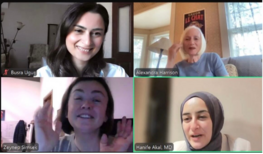
Figure 5: The international team behind the project, bringing energy and enthusiasm to every meeting.
Conflict of Interest
The authors created the workbook as a freely distributed, non-commercial resource. No financial interests declared.
This article represents the view of its author(s) and does not necessarily represent the view of the IACAPAP's bureau or executive committee.
